
https://researchdirect.westernsydney.edu.au/islandora/object/uws%3A12868


 |
| SOLD |
https://researchdirect.westernsydney.edu.au/islandora/object/uws%3A12868
|
| SOLD |
 While facing the limitation of space, and as the ideas continue to flow there is another limitation that provides me with an emotional and tangible boundary for getting to the essence of this croning period specific to Jan’s personal life. It helps to work with one image at a time: the moon phases in the southern hemisphere is the starting point. The phases of the moon visually embody the three major stages of a woman’s life: the Virgin girl, the birthing, nurturing Mother, and the wise woman Crone. Typically they are defined by the powerful stages of female sexual activity, as the names suggest. But the crone image seems to have forfeited – or more accurately, been deprived of her power in recent culture, leading her to be seen as a disempowered and withered woman, often taking on the negative attributes of the bitter, backward old witch who is out of touch. She is maligned and condemned not only as being out of date, but claimed to be malicious towards others in her community and society, for which she has been burned at the stake over hundreds of years.
  So, back to the moon imagery for these three stages. An older representation of the dark moon that had been saved from a previous project provided the initial impetus. A full dark moon sitting on a dark red background, both hand dyed, seemed to be a good place to start. It was a case of deciding whether to included a visible impact for the last stages of the moon as it wanes, unable to be seen from most positions on earth. Being intent on including the Virgin crescent moon, the full red moon of the Mother has allowed the rightful places of both Virgin and Crone, with each embracing the other, residing comfortably within each other within the all encompassing arms of the Mother.
 The Utroba cave, also know as the ‘womb cave’ is such a destination, a ritual that involves entering into the dark recesses of the cave in order to maintain life, while paying tribute to the pleasure-giving clitoris protruding above the entrance. From what I read, these natural temples of worship and honour to woman are not uncommon across the European continent, and may serve to remind us that we come from the womb of Mother Earth, and to Her we return in death. Although this image of the Sheela carved in stone has also been found throughout Europe, her image is prevalent and has lasted on churches in Ireland. Who is she? The image that dominates is a woman’s vulva; she is holding it open with both hands, arms looped behind her thighs, as though in invitation. Perhaps it is quite confronting in this day and age, in spite of the plethora of pornography available. What does she represent? There are very probable theories in the Christian era that it was designed to be a warning about where the sins of the flesh for the ‘faithful’, obviously initiated by women. Remember also Pandora’s box (there seems to be a pun there), or her ‘vase’ that supposedly poured out all the evils in the world? The image of the Sheela holds within the traditions of the past, present and future, and is the kindly guardian of entrance into the Underworld. The ability to draw aside the veils and see between the worlds with the heart and soul is to see that which is invisible to our eyes or what lies beneath the visible, thereby animating the creative forces for change through an enhanced intuition and insight.
  |
| Kali Ma embodies the Sheela |




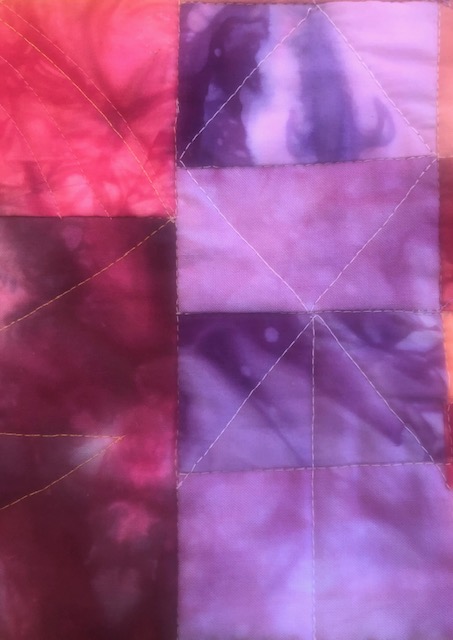
Here we go, with the aim to complete posts for this quilt as I seek to complete the 'topography' of the quilt. I have already ditch-quilted the strips to hold the three layers together before adding the final binding. Yep. I know - the wrong way round. But questions remain: how best to embed the symbols I’ve chosen – machine quilted, or hand-stitched? All layers have already been ditch stitched to hold the three layers together, so there is no quilting visible. Whether to use fine threads, or embroidery thread? I’m inclined to do both, as a mirroring process; but will too much special quilting detract from the overall impact? Practical thought comes to mind: machine stitching is so much faster (and other designs are on the back burner).
 |
Runes are another familiar set of ‘alphabet’ symbols originating long before lineal script, in the areas in northern European continent of Germanic and Viking peoples, who associated them with their god Odin. By expressing human qualities and characteristic emotions, they were used largely for divination – or as some say, the powers of cosmological principles. The word 'rune' acknowledges the ‘mystery’, the secret that is deeply embedded in the human psyche imparted from a relationship to the wider cosmos, as well as physical attributes related to fertility, continuity and abundance.

Ancient symbols have carried over into other cultural institutions. The hexagram is the six-pointed star, formed by two interlocking equilateral triangles, one pointing up the other downwards. Used in many cultures and religious beliefs, it can be representing male and female in perfect harmony; as above, so below – the human position between earth and the cosmos; and the interconnection between opposites, dark and light. Overlapping hexagrams (as fractals) result in numerous intersecting points that resonate higher energy frequencies, thereby forming downward pointing several diamond shapes of the sacred vulva of rebirth.
 |
Another form of star that has evolved with significant meaning in different contexts is the five pointed star. For example, as the Eastern Star of five points in Masonic symbolism expresses the importance of knowledge that is a guide to spiritual fulfillment and self knowledge. Called a pentacle in pagan earth-centred spiritual traditions depictions and rituals over millennia, it is often contained by a circle (reminding me of the DaVinci man), each point touches the diameter. It is also the way that I like to sign the first letter of my name 'A', which is easily struck in five strokes of the pen.


I'm finding it difficult to bring the quilting to an end, but I want to hang it and get on with the next - well, the others as yet unfinished - and I can always add more as the spirit moves. Throughout the process of creation, I contemplated many different names that related to the daily cycle of dawn and dusk, sunrise and sunset, following on from the original inspiration of the magnificent colours at all times of day. The moon and sun are both present, and considering their daily romantic dance of attraction to each other, I have decided on Together apart.
Internet is opting out for now, so will post final images tomorrow.
This is still a work in process, though coming towards a conclusion. I have started towards quilting the three layers together... for next post.
 |
In order to construct that narrative visually, there is another need: to consider perspectives with regard to the fabric placement, and how they will tell their story. Will it have an aerial viewing point, as in many Indigenous works of the dot painting genre; or vertical/horizontal layered perspective – taking eye to move up and down and across? Or both? Is there to be a focal point, or several? David Hockney used a technique that he called 'joiners', based on the premise that singular and unified optical vision comes about through joining a series of multiple perceptions that come together to create the unified whole of normal vision.
Hockney’s ‘joiners’ aim to create an image able to show reality as we experience it – in fragments, rather than as a completed whole, but as part of the passage of time. It is brought about by collage, using two or several separate images of a single scene by overlapping them or forming a geometric grid. As a composite of a single scene, the image nevertheless has a single narrative that is not static, but engages a roving eye that darts from one area to another. The effect is to alter the usual ‘realism’ that creates the illusion of depth of field. And the aim of his joiners is to reflect the real process of seeing, one based on visual experience as the eye moves across multiple plains, having fluid and multiple viewing points. Unlike the perspective that arrives at the destiny of the vanishing point, the eye moves around, back from the point on the horizon towards the multitudes of vision closer to the viewer, taking her in as a participator as the viewpoint shifts.
Hockney's Bigger Grand Canyon in the collection of the Australian National Gallery is a notable example of his joiners, being made up of 60 canvases joined to create a work of 7.4 metres in width. It uses a reverse perspective to draw the viewer into the environment being depicted, rather than looking in from the outside. This form of ‘reverse perspective’ creates a viewing point, one that draws the viewer into the scene that has been achieved in traditional Chinese art by using the diagonal to cut across the distance perspective attained in Western realism art. His fascinating work on the use of linear perspective is Secret Knowledge: rediscovering the lost techniques of the Old Masters (2001, Thames and Hudson), detailing the use of optical devices over the centuries during the Renaissance to create photographic images for patrons in particular.


